Hidden Bazaars & Artisan Alleys: Patan’s Secret Shopping Soul
You know that feeling when you stumble upon a place so authentic it feels like the map hasn’t caught up yet? That’s Patan, Nepal—where shopping isn’t about malls, but moments. Tucked behind temple spires and cobbled courtyards, its niche markets pulse with hand-carved secrets and silk whispers. I went searching for souvenirs and found something rarer: craftsmanship alive, raw, and deeply rooted. This is shopping with soul, not spectacle. In a world where tourism often flattens culture into trinkets, Patan resists. Here, every purchase is a conversation, every object a legacy. This guide unveils the quiet brilliance of Patan’s artisan economy—not as a checklist, but as an invitation to engage, observe, and honor.
The Pulse of Patan: Where Culture Meets Commerce
Patan, also known as Lalitpur, is not merely a city with crafts; it is a city built by them. For over a millennium, its identity has been shaped by the hands of artisans whose skills have been passed down through generations. Unlike tourist markets designed for spectacle, Patan’s commerce emerges organically from its living heritage. The city was once a powerful independent kingdom and remains one of the three historic royal cities in the Kathmandu Valley. Its deep-rooted Newari culture places immense value on artistry, where craftsmanship is not a trade but a sacred duty. This cultural ethos infuses every transaction, transforming shopping into a quiet act of preservation.
Walking through Patan feels like moving through a three-dimensional museum where the exhibits are not behind glass but in use, in motion, in creation. Metalworkers shape ritual bowls in the same alleyways where their ancestors forged temple bells. Woodcarvers chisel window frames with motifs unchanged for centuries. The rhythm of the city is tied to the tap of mallets and the hum of handlooms. This continuity is why Patan was designated a UNESCO World Heritage Site—the entire urban fabric reflects a civilization that values beauty, precision, and spiritual symbolism in everyday life. Shopping here is inseparable from this cultural pulse.
What sets Patan apart from more commercialized destinations is the absence of mass production. There are no factories churning out souvenirs. Instead, each item is made in small workshops, often within family homes, where multiple generations collaborate. A brass oil lamp may take days to complete, with every curve hammered by hand using centuries-old repoussé techniques. A thangka painting—a detailed Buddhist scroll—can require months of meticulous brushwork. These are not products; they are heirlooms in the making. Visitors who understand this depth often find themselves not just buying, but bearing witness to a way of life.
The city’s role as a craft hub is not accidental. Historically, Patan was a center of trade and pilgrimage, attracting merchants, monks, and artists from across Asia. Its location along ancient Himalayan trade routes allowed for the exchange of ideas, materials, and techniques. Over time, this cross-pollination refined local artisanship, blending indigenous Newari traditions with influences from Tibet, India, and beyond. Today, this legacy lives on not in textbooks, but in the daily work of artisans who continue to supply temples, households, and collectors with objects of both utility and devotion. To shop in Patan is to participate in a continuum that stretches far beyond the present moment.
Patan Durbar Square and Its Surrounding Craft Clusters
The heart of Patan’s artisan economy beats strongest around Patan Durbar Square, a UNESCO-protected complex of palaces, temples, and courtyards that serves as both a spiritual and cultural anchor. From this central plaza, narrow alleys fan out like veins, carrying the lifeblood of craftsmanship into the surrounding neighborhoods. These pathways are lined with small, unassuming workshops where artisans work in full view of passersby. There is no need for shopfronts or signs—craftsmen sit just beyond open doorways, their tools in hand, their focus unwavering. This transparency invites observation, turning a simple stroll into an immersive experience.
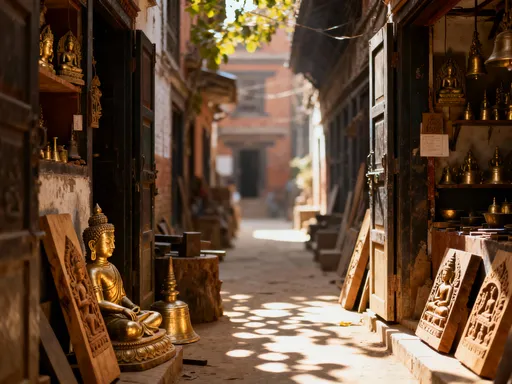
One of the most renowned craft clusters surrounds the square’s eastern edge, where metalworkers specialize in bronze and brass ritual items. These include *diyo* (oil lamps), *kalash* (holy water vessels), and intricate statues of deities. Many of these artisans belong to the Shilpakar caste, a traditional community of metal craftsmen whose lineage in Patan dates back over 700 years. Their techniques, such as lost-wax casting and hand-hammering, are taught through apprenticeship rather than formal education. Visitors can watch as molten metal is poured into clay molds, or as a craftsman painstakingly engraves floral patterns onto a temple bell. The air carries the scent of burning wax and hot metal, a sensory reminder of the alchemy at work.
Just a few steps away, in the alleys behind the Krishna Temple, stone carvers shape sandstone and slate into deities, doorframes, and decorative panels. These carvers often work on commission for temple restorations or private homes, ensuring that traditional architectural styles endure. Their tools—chisels, mallets, and measuring rods—are simple, yet their precision is extraordinary. A single misstep could ruin weeks of labor, yet their confidence is evident in every strike. Some workshops allow visitors to try their hand at basic carving under supervision, offering a rare tactile connection to the craft.
Equally compelling are the thangka painting studios tucked into the upper floors of old brick buildings. Thangka artists, often monks or trained lay practitioners, spend hours each day applying mineral pigments to cotton canvas. The process is meditative, governed by strict iconographic rules that ensure spiritual accuracy. From a distance, the paintings shimmer with gold leaf and vivid colors; up close, the details are breathtaking—tiny lotus petals, swirling clouds, and the subtle expressions of enlightened beings. Many studios welcome visitors to observe, provided they maintain silence and respect the sacred nature of the work. Purchasing a thangka is not a casual transaction; it is an acknowledgment of devotion and discipline.
The Hidden Courtyards: Patan’s Off-the-Beaten-Path Workshops
Beyond the well-trodden paths of Durbar Square lie Patan’s *bahals*—traditional enclosed courtyards that serve as both residential spaces and creative sanctuaries. These *bahals* are the city’s best-kept secrets, housing master craftsmen who work in relative obscurity. Unlike the more accessible workshops near the square, these artisans are not always visible to casual tourists. Their doors are unmarked, their presence known only through local connections or guided walks led by community-based tour operators. Gaining entry is not about privilege, but about respect—many artisans welcome visitors who approach with genuine curiosity and humility.
One such courtyard, tucked behind a narrow alley in the Sundhara neighborhood, is home to a fifth-generation woodcarver specializing in *tiki* windows and *toranas* (lintels). His workshop occupies a corner of the courtyard, where sunlight filters through intricate wooden screens he once carved himself. Here, he works with a small team of apprentices, shaping deodar wood into mythological scenes—gods riding celestial animals, dancers frozen in mid-motion, and guardians with fierce expressions. The tools are simple: chisels of varying widths, mallets made of hardwood, and measuring cords. Yet the results are anything but ordinary. Each piece is unique, bearing the subtle imperfections that mark it as human-made.
Another hidden gem is a repoussé metal studio in a *baha* near Yala. The artisan, a soft-spoken man in his sixties, learned the craft from his father and now teaches it to his son. His specialty is crafting ritual masks used in religious festivals. These masks, made from thin sheets of copper or brass, are shaped entirely by hand, hammered from the reverse side to create raised designs. The process can take weeks, with each curve refined through countless delicate strikes. Visitors who are invited inside often describe the experience as humbling—the quiet focus, the rhythmic tapping, the reverence for tradition. These are not performances for tourists; they are daily acts of cultural stewardship.
Access to such spaces is often facilitated by local guides or cultural cooperatives that prioritize ethical tourism. These organizations ensure that visits are brief, respectful, and mutually beneficial. Some artisans even offer short demonstrations or allow visitors to try basic techniques under supervision. The goal is not to turn workshops into attractions, but to foster understanding. For travelers, the reward is not just a beautiful object, but a story—one that cannot be found in guidebooks. These hidden courtyards are where Patan’s soul resides, not in grand displays, but in quiet dedication.
From Threads to Treasures: Textile Shopping in Patan
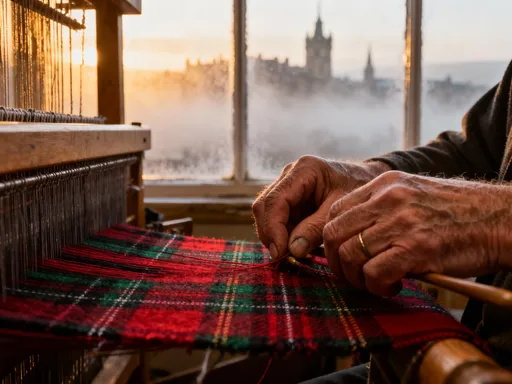
Textiles in Patan are more than fabric—they are narratives woven into thread. The city is renowned for its handwoven *pattu* cloth, a thick, durable wool traditionally used for winter garments, and *dhaka*, a vibrant cotton fabric characterized by intricate geometric patterns. These textiles are not mass-produced; they are crafted on handlooms by weavers who follow ancestral techniques. Many of these weavers are women from Newari families who have preserved the art within their households for generations. Their work is now gaining recognition through cooperatives that ensure fair wages and sustainable practices.
One of the most respected weaving initiatives is the Patan Dhaka Weaving Center, a community-based project that supports local artisans while maintaining the authenticity of the craft. Here, visitors can watch weavers at work, their hands moving swiftly between warp and weft, creating patterns that have adorned Newari weddings and festivals for centuries. The colors—deep reds, mustard yellows, forest greens—are derived from natural dyes, including madder root, indigo, and lac. Each piece can take days or even weeks to complete, depending on complexity. The center also offers workshops where travelers can try basic weaving techniques, gaining firsthand appreciation for the skill involved.
Traditional Newari attire, such as the *haku patasi* (a black sari with red border) and *tapalan* (a fitted blouse), are commonly available in local boutiques and cooperatives. These garments are not just fashion statements; they are symbols of cultural identity. Many women in Patan still wear them daily, especially during religious ceremonies and family events. For visitors, purchasing such clothing is a way to honor the culture, provided it is done with respect. Ethical shops often include information about the weaver and the significance of the design, turning each garment into a story-bearing object.
However, not all textiles sold in Patan are authentic. With rising tourism, some vendors offer machine-made imitations labeled as handmade. To identify genuine pieces, travelers should look for slight irregularities in the weave, uneven dye absorption, and the weight of the fabric. Handwoven *dhaka* has a distinctive texture—slightly rough, with a natural stiffness that softens over time. Additionally, reputable shops often allow customers to meet the weavers or see the looms in person. Supporting authentic textile artisans ensures that this delicate craft survives in an age of fast fashion.
Ceramics, Bronze, and Beyond: Specialty Shopping by Craft Type
Patan’s artisan economy thrives on specialization, with different neighborhoods and families focusing on specific materials and techniques. This division of labor ensures mastery, with each craft reaching a level of refinement that is difficult to replicate elsewhere. For travelers, this means shopping becomes a journey of discovery—each material offering its own aesthetic, history, and cultural significance.
Bronze and brass items are among the most sought-after souvenirs. Foundries near the temple zones produce ritual objects such as *bells*, *butter lamps*, and *standing deities* in postures of blessing or meditation. These are not merely decorative; in Newari and Buddhist traditions, they serve functional roles in daily worship. The lost-wax casting method, still used today, involves creating a wax model, encasing it in clay, and then melting the wax away before pouring in molten metal. The resulting piece is then hand-finished with chisels and polishing stones. Because each mold is destroyed in the process, no two pieces are exactly alike—a detail that adds to their value.
Ceramics in Patan reflect both utility and artistry. While the nearby village of Khokana is better known for pottery, Patan hosts several potters who create terracotta items ranging from cooking pots to ornamental tiles. These potters use foot-powered wheels and wood-fired kilns, methods unchanged for centuries. Their work often features simple, elegant forms with minimal decoration, allowing the natural texture of the clay to speak for itself. Some artisans also produce *maka* (oil lamps) shaped like lotus flowers or animals, used in home shrines and festivals. These pieces are not only beautiful but biodegradable, aligning with sustainable living practices.
Stone carving remains another pillar of Patan’s craft identity. Artisans in this field often work on commission, creating everything from miniature deity statues to full-scale architectural elements. Sandstone, slate, and marble are carefully selected for their grain and durability. A single stone *gargoyle* or *guardian figure* can take weeks to complete, with every detail carved by hand. Some workshops allow customers to request custom pieces, such as a small *Buddha head* or *mandala plaque*, which can be shipped internationally. These items carry not just aesthetic value, but symbolic meaning—representing protection, enlightenment, or spiritual balance.
Navigating the Experience: Practical Tips for Mindful Shopping
Shopping in Patan is as much about how you engage as what you buy. Unlike commercial markets where transactions are quick and impersonal, Patan’s artisan economy rewards patience, presence, and respect. To make the most of the experience, travelers should approach it not as consumers, but as cultural participants. A few practical guidelines can enhance both the journey and its impact.
Bargaining is common but should be done respectfully. Many artisans set fair prices based on the time, skill, and materials involved. While some flexibility exists, especially for larger purchases, haggling aggressively undermines the value of their work. A better approach is to ask about the making process—how long it took, what techniques were used. This not only builds rapport but often leads to a natural discussion of price. In many cases, artisans appreciate genuine interest more than a slightly lower offer.
Timing matters. Early mornings are ideal for visiting workshops, as this is when most artisans begin their day. Studios are more likely to be open, and the light is perfect for observing details. Afternoons, especially during festivals or religious events, may see closures. Carrying small bills is helpful, as many workshops do not have change for large notes. Patience is essential—some artisans may pause their work to speak, while others prefer minimal interruption. Observing quietly is often the most respectful approach.
Authenticity can be verified through observation. If possible, see the item being made or meet the maker. Reputable cooperatives and community centers often provide certificates of origin or weaver profiles. Avoid vendors who cannot explain the craft behind their goods. Finally, consider the purpose of your purchase. Is it a souvenir, a gift, or a meaningful addition to your home? Choosing items with intention ensures they are valued long after the trip ends.
Why Patan’s Shopping Stands Apart—And How to Honor It
In an era of globalized commerce, Patan’s artisan economy stands as a quiet resistance to homogenization. Here, shopping is not about acquisition, but connection. Each object carries the imprint of a hand, a history, a belief. Unlike mass-produced souvenirs that fade into clutter, these crafts endure—not just in durability, but in meaning. They are not made for tourists; they are made for life.
What makes Patan unique is not just the quality of its crafts, but the integrity of its process. Artisans do not perform for cameras; they work because their craft is their identity. Visitors who honor this by engaging mindfully become part of a larger story—one of preservation, dignity, and cultural continuity. The responsibility does not end at purchase. It extends to how we speak of these objects, where we display them, and whether we credit their origins.
Travelers leave Patan with more than bags of souvenirs. They carry stories—of a woodcarver’s steady hands, a weaver’s patient rhythm, a metalworker’s quiet focus. These moments linger, shaping how we see beauty, labor, and tradition. In choosing to support Patan’s artisans, we do not just buy art. We help keep it alive. And in doing so, we honor not just a place, but a way of being that refuses to be forgotten.